NDN
Warriors on Independence Day
By Roy Cook
The
fourth of July is a United States federal holiday. This is a fine time to recognize
the military service of our Federal, State and non- government recognized Tribal
American Indian Warriors. On many Tribal Nations land gatherings, pow wows, parades
and celebrations take place on the Fourth of July.
NDN
Warriors have always defended this great land for all the people. We appreciate
and Honor our Military Veteran Warriors whom have stood on the battle line in
combat to defend this land and our Indian Nations.
Just less than a few
generations ago the way of life for Native people in America was very different.
Just to provide a little perspective of American Indian history, it was not until
1924 that Native Americans were named United States citizens. And the state that
I was born in 1943, Arizona, did not ratify this law until 1948. This is after
my three uncles served in WW II and my cousins entered the military, along with
myself, later also.
"Kill the Indian to save the man" --
that oppressive motto led to restrictions on many tribe's native language and
native customs.
The federal government forced Indian children to go to
denominational churches and boarding schools where they were re-educated, acculturated
and stripped of their cultural traditions in an attempt to assimilate them.
So
it makes sense that, growing up, the Fourth of July would be a dark day, a sad
tribute to the country that tried and tried again to exterminate its native people
and their culture. But it wasn't because Native American people are adaptable
on the Fourth of July. Snow Cones and barbecues weaved together with older, indigenous
traditions like music, song and powwows that would last deep into the night.
At
the center of the festivities is the drum. "The beat of the drum means everything
in the powwow. It signifies the heart beat of a people. There are different types
of dances, ceremonies, give-aways and acknowledgements."
So what are Tribal
people celebrating?
It is amazing that those that struggle the most, and
who've been forced to be the most creative to survive are those that have the
most to teach us. As a Nation of many cultures and ethnicities we can learn forgiveness
without forgetting with incredible creativity and resilience.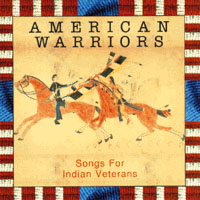
At
one point, for many decades and on many Reservation's, the white Bureau of Indian
Affairs, BIA, superintendent issued a declaration that read like this: "Dancing,
exchanging of presents, traveling from one dance to another, and dancing feasts
are not to be carried to excess."
The BIA superintendents decreed
that permission for all traditional dances must be obtained in writing except
for gatherings that were on the Fourth of July. The
Fourth of July, after all, was the time to teach Indians how to become good Americans.
Some Indian children were even reassigned new birthdays to coincide with the Fourth.
By the early 1900s, the Fourth had become a big day on the reservation, starting
at dawn and lasting well in to the evening with traditional dances and ceremonies.
The
Fourth of July, after all, was the time to teach Indians how to become good Americans.
Some Indian children were even reassigned new birthdays to coincide with the Fourth.
By the early 1900s, the Fourth had become a big day on the reservation, starting
at dawn and lasting well in to the evening with traditional dances and ceremonies.
All
kinds of singing and dancing, exchanging of gifts. People would visit friends,
initiate people into societies and do all the sorts of things that they were ordinarily
prevented from doing, under the cover of this patriotic celebration.
For
more than a century, the Fourth of July has been a big day across Indian country.
The Quapaw, Pawnee, Ponca, Kiowa and many other tribes in Oklahoma, the Ojibwe
in Minnesota and the Northern Cheyenne in Montana are just a few of the tribes
that have established big rodeos and powwows on the Fourth -- celebrating the
day, but making it their own.
Of course, not all tribes or all Indian people
have embraced the holiday in the same way. The Onondaga of upstate New York decided
a few years ago to stop observing the Fourth of July altogether. Right after America
declared independence in 1776, George Washington ordered Onondaga villages to
be destroyed -- they were in the way of the new country. The film "Smoke
Signals" by writer Sherman Alexie of the Spokane and Coeur D'Alene tribes
captured the bitterness the day can bring in a scene between a father and son
who are driving home on the Core D'Alene reservation one Fourth of July: "Happy
Independence Day, Victor," the father says to his son with more than a hint
of sarcasm. "Are you feeling independent?"
That line made Michelle
Singer, a member of the Navajo tribe, laugh out loud when she saw it in the theater,
but she has mixed feelings about Independence Day. One the one hand, when she
is at Independence Day barbecues with her little brother, "he and I would
certainly joke about the irony of this being Independence Day, and yet when you
think about it's the beginning of the dominance of Euro culture, if you will."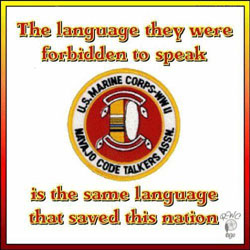 On
the other hand, her grandfather was a Navajo "code talker" during World
War II, and she relishes the chance that the Fourth provides -- to honor him and
his fellow veterans. Native Americans enlist in the military at far higher rates
than any other group of Americans.
On
the other hand, her grandfather was a Navajo "code talker" during World
War II, and she relishes the chance that the Fourth provides -- to honor him and
his fellow veterans. Native Americans enlist in the military at far higher rates
than any other group of Americans.
"We came from homes where our parents
didn't have a college education, and here we were in our nation's capital, working
in some pretty influential positions, and yet we were just these Indian kids,"
she says.
The birth of this country came with caveats. But in the glow
of those fireworks, it seemed to Singer that, somehow, both her countries -- her
sovereign tribe and the place that issued her passport -- might one day figure
things out and change.
http://weekendamerica.publicradio.org/display/web/2008/07/02/4th_rez/
Native
America: What will the signs of change be?
When the lands are given
back to us, and we don't have to do fund raisers or occupations to get them back
;
When the buffalo are not hazed and killed by government agencies; 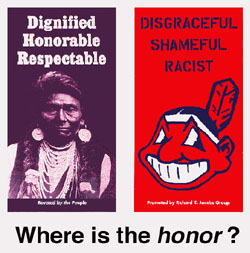 When
rocks are not sold as souvenirs on Alcatraz ;
When
rocks are not sold as souvenirs on Alcatraz ;
When Indian names and images
are not used as Sports mascots or for commercial selling of products ;
When
we can have equal time in our classrooms across the United States to learn and
speak our languages so they are not lost forever;
When we have funding in
our schools so our children can learn;
When all tribes can be nationally "recognized"
;
When we can keep our casino monies and take care of our own;
When we
all have health care, card carrying or not ;
When we can have statues that
also commemorate our own people;
When we can change historical markers to
reflect the truth and not glamorize the murders;
When we can see curriculum
in our school books and classrooms that are not romanticized or glossed over when
it comes to what really happened in and around Indian Country ;
When we don't
have to ask permission to hunt and gather for sustenance, ceremony, or for medicinal
reasons;
When all Sacred Sites are in place (and protected);
When our
ancestors remains or artifacts are uncovered, the corporation or
construction
companies JUST STOP and find a different place to build;
When DJ's of commercial
radio stations stop putting Indian people down;
When we can get our Indian
Trust $$$ back out of the US Government's hands;
When we can get adequate
and efficient housing for all Reservations & Rancherias & there is no
waiting list ;
When we can get more of a variety of commodity foods and some
fresh food...like eggs, milk, etc ;
When we can all have enough land given
back to grow our own foods; 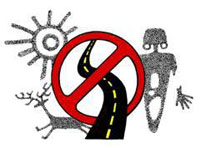 When
our reservations are no longer used as toxic and nuclear waste dumps;
When
our reservations are no longer used as toxic and nuclear waste dumps;
When
the US Government apologizes and is held to answer for the atrocities and genocidal
acts it did against countless Native American people ;
When our President
makes a visit to each Reservation and realizes what the USA has re-created in
Afghanistan, Iraq and countries to come;
When our ceremonies are not sold
by those who disrespect the pipe, the sweat lodge, the sun dance and the things
that help us heal ;
When we can get roads, water, power, phones, WiFi and
computers to the Reservations & Rancherias that are without these things;
When we have a gym, clinic, wellness center, etc on each and every Reservation;
When we have our own radio station on each Reservation;
When we have more
kids graduate from High school and college;
When we have adults returning
back to school and getting their GED;
When we have less or no Indians in Prison
and jail or political prisoners like Leonard Peltier;
When we have more rehab,
preferably traditional and native way facilities ;
When we have more prevention
programs and activities on the Reservation;
When poverty dissipates and children
and adults do not have to go hungry;
When women are not referred to by ‘squaw’
or men by ‘chief’.
On
the 4th of July we Remember our Gulf War NDN Warriors. During the Desert Storm
conflict more than 3,000 American Indians served in the Gulf region.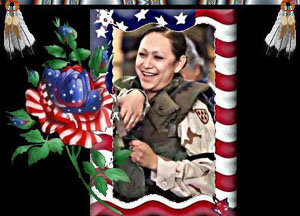
Several
American Indians lost their lives in the Gulf War, including Lori
Piestewa,
a Hopi Indian from Arizona, who died in the ambush in which
Jessica Lynch and
her compatriots were captured. Squaw Peak in
Arizona was officially re-named
Piestewa Peak in her honor.
As of 1980, at least 60 women served as Eskimo
Scouts in the Alaska National Guard, patrolling the western Alaska coastline.
The Eskimo Scouts, organized during WW II, represent the only unit of the Alaska
Guard to have a continuous active duty mission.
We Honor our American
Indians on current Military Active Duty:
As of March 2012 the Pentagon
estimates that since 2001, 64 American Indians and Alaskan Natives have died fighting
in Afghanistan and Iraq (42 in Operation Iraqi Freedom; 22 in Operation Enduring
Freedom (Afghanistan)). The Pentagon also reported in March that 22,248 American
Indian/Alaska Natives (AI/AN) currently serve in the military (active duty). Native
personnel serve across the Armed Forces at the following levels; Army: 4,404;
Navy: 13,511; Marine Corps: 2,128; and Air Force: 2,205. The 2010 U.S. Census
estimates that there are currently 156,515 American Indian and Alaska Native veterans.
(Source: 2010 American Community Survey for the American Indian and Alaska Native
alone population)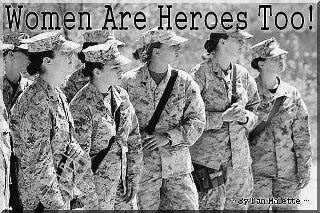
According
to Department of Veteran Affairs, in 2006 more than 36,000 female veterans are
AI/AN, representing almost 10 percent of all AI/AN veterans, and nearly twice
the national average (6 percent of women in the overall population are veterans).
http://www.ncai.org/news/articles/2012/05/25/native-military-service-and-memorial-day-statement-by-ncai-president-jefferson-keel